
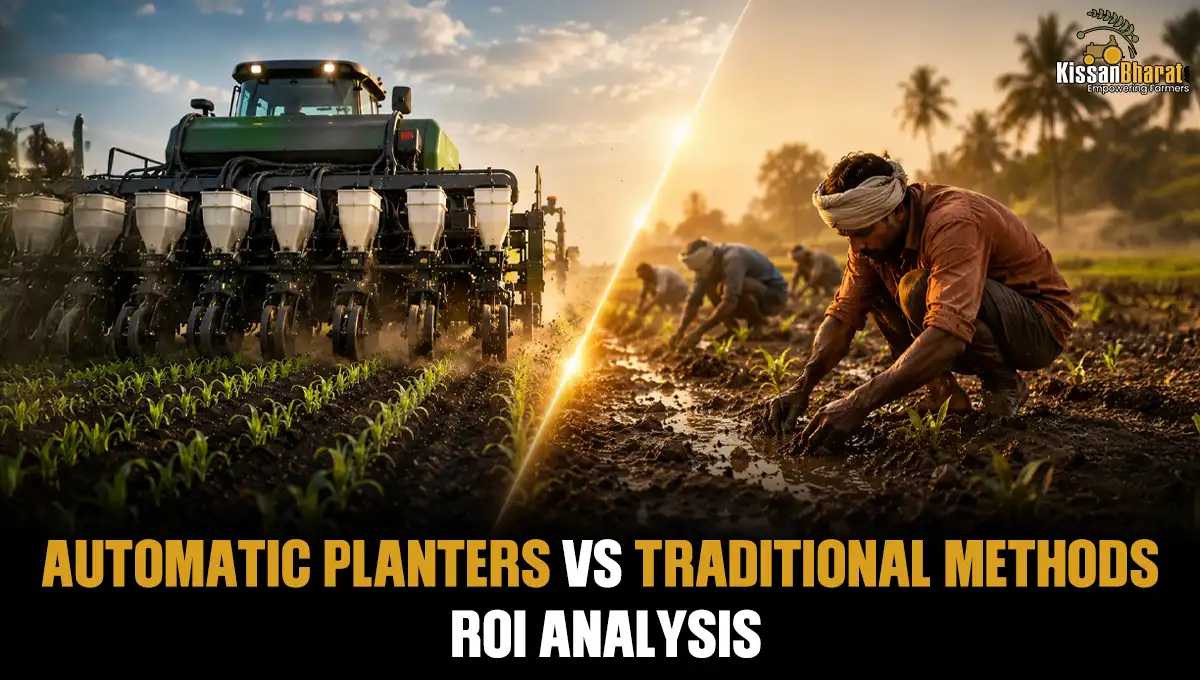
Planting is a critical stage in modern farming, and the method you choose can directly impact productivity and profit. Today, farmers are moving from Traditional Methods like manual planting to advanced solutions like Automatic planting systems.
But is this shift really worth the investment? Understanding Automatic Planters vs Traditional Planting is essential before making a decision. While traditional methods require less initial costs, modern machines guarantee better efficiency and higher yield. In this blog, we’ll break down the ROI, performance, and practical differences to help you choose the right approach for your farming needs.
What is Manual Planting?
Manually sowing crops is an age-old system, whereby planting is done manually using very basic instruments. It is the most common practice employed in small holdings, being among the oldest methods of cultivation.
Although this process takes more labor and time, the input capital required is very minimal. Nonetheless, such cultivation practices tend to produce uneven and poor crop development.
Although manual cultivation seems quite simple, it has some limitations within modern large scale agricultural operations.
What is Automatic Planting?
Automatic planting involves the use of machinery, such as automated planters, that automatically plant the seeds accurately and quickly. Automated machinery plays a vital role in agricultural farming as they increase efficiency. Automated planting guarantees consistent spacing, proper seed depth, and increases speed.
The use of automated machinery is increasing because they boost productivity and minimize the need for manual labor. For individuals seeking increased productivity on their farms, then automated planting is the best option.
Automatic Planters vs Traditional Methods
|
Factor |
Automatic Planters |
Traditional Methods |
|
Planting Accuracy |
High precision |
Uneven spacing |
|
Labor Requirement |
Low |
High |
|
Time Efficiency |
Fast |
Slow |
|
Initial Cost |
High |
Low |
|
Yield |
Higher |
Moderate |
|
Scalability |
Suitable for large farms |
Suitable for small farms |
ROI Analysis: Which One is More Profitable?
When comparing Automatic planters vs traditional planting, ROI is a key factor.
Traditional Methods have low initial cost but higher labor expenses over time. They also result in moderate yield due to uneven planting.
In contrast, Automatic planting systems require higher upfront investment but deliver better long-term returns. They reduce labor costs, save time, and improve yield through precision planting.
In simple terms, traditional methods may save money initially, but automatic planters offer higher profitability in the long run.
Advantages of Automatic Planting
There are numerous advantages that come with using automatic planters in contemporary agriculture.
This type of planter increases the efficiency of planting, resulting in the growth of healthier crops that will have increased yields.
In addition, less labor will be needed for planting activities, which is a significant advantage given the current agricultural setting.
The use of automatic planters ensures that farmers are able to plant in large areas without delays.
The final advantage is resource optimization, whereby seeds are utilized more effectively.
Advantages of Traditional Methods
Conventional Techniques such as Manual Planting also have their advantages.
They involve little capital expenditure, rendering them affordable for smaller farms. The conventional approaches are also versatile and not machine-dependent.
Manual planting is feasible and practical for small plots of land. They are also useful in ensuring that the farmer pays close attention to each planted seedling.
Nonetheless, although conventional practices are cheaper at the outset, they might not be as efficient as contemporary farming methods.
When to Choose Which Method
The choice between Automatic planters vs traditional planting depends on your farm size, budget, and goals.
If you have a large farm and want higher productivity, Automatic planting is the better option. It saves time and increases yield.
For small farms with limited resources, manual planting may still be practical.
Many farmers adopt a gradual approach, starting with traditional methods and slowly shifting to modern farming equipment for better efficiency.
Conclusion
Ultimately, the choice to adopt Automatic Planting systems versus Traditional Planting systems is simply one of efficiency versus cost-effectiveness. Although Traditional Methods are cheap and straightforward, Automatic Planting provides increased precision and high yield production.
In the current era of technological farming, choosing the best machinery could prove fruitful for your venture. Select wisely and make an informed decision according to your own needs and capabilities.